



@ABDanielleSmith Chineese communist Part is using PR to push bad media about data centers. They fund organization to push this.
This way only China controls the housing of Data centers. pic.twitter.com/eGXhxjMjvc
— La Vatoria (@LavalaMichelle) August 3, 2026
The United States is done playing defense in the artificial intelligence race. While China pours concrete, builds power plants, and scales compute at breakneck speed, America is finally placing its most critical AI infrastructure where it belongs: behind the wire on U.S. military bases. This, while China pays off Liberal and Conservative influencers and media in the U.S. to organize protests of datacenters and stop their rollout so China can beat us in the A.I. race.
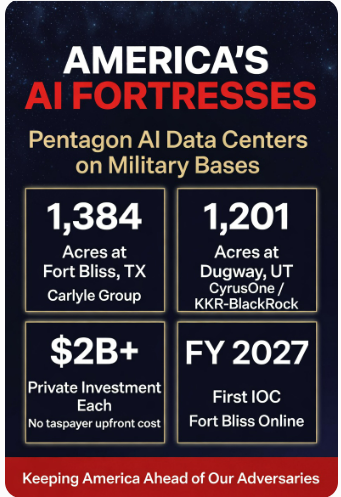
The Pentagon is moving aggressively to site hyperscale AI data centers on installations across the Army and Air Force. This is not some bureaucratic experiment. It is a strategic recognition that the future of American military superiority — and the nation’s ability to stay ahead of the Chinese Communist Party — depends on secure, scalable computing power that cannot be easily disrupted by protests, lawsuits, or foreign-influenced obstruction.
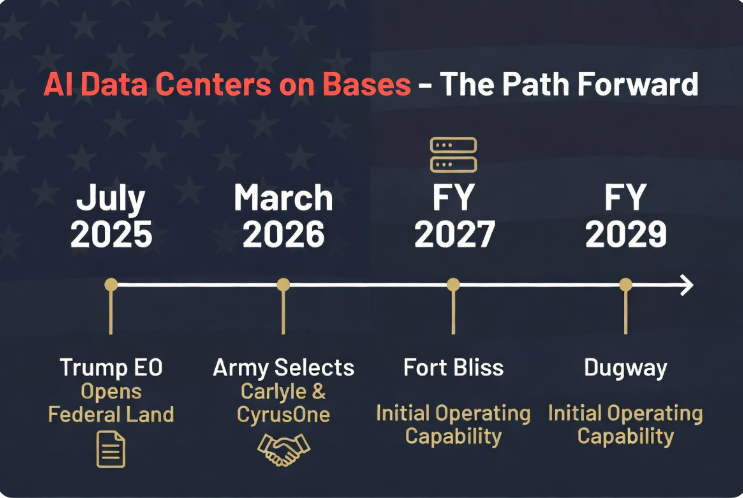
Underutilized land at bases is being opened through the Army’s Enhanced Use Lease program, powered by a Trump executive order directing federal agencies to accelerate data center development on non-excess federal property. Private capital does the heavy lifting. Companies finance, build, operate, and eventually decommission the facilities. Taxpayers put up no upfront money. In return, the military gains dedicated access to the computing power it needs for AI-driven systems.
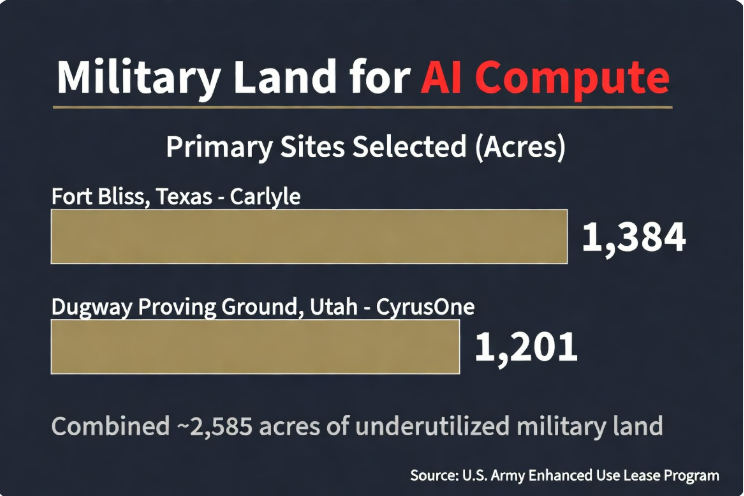
Two conditional deals are already advancing. Carlyle was selected for roughly 1,384 acres at Fort Bliss, Texas. CyrusOne, backed by KKR and BlackRock funds, was picked for about 1,201 acres at Dugway Proving Ground in Utah. Each project is estimated in the $2 billion range. Initial operating capability is targeted for fiscal 2027 at Fort Bliss and fiscal 2029 at Dugway. The Air Force has solicited proposals for multiple other installations, including sites in Tennessee, California, Arizona, Georgia, New Jersey, and Alaska. More Army locations, including Fort Hood and Fort Bragg, have been under consideration.
Army Secretary Dan Driscoll put it plainly: “AI is a strategic asset for the Army. It is a force multiplier, supports future transformation and requirements, keeps the Army ahead of our adversaries, and generates resiliency across the force.” He has described the Fort Bliss project as the first hyperscale data center the Pentagon has ever done.
This approach delivers three decisive advantages that civilian projects simply cannot match.
First, physical and operational security. Data centers on military installations sit inside controlled perimeters with armed security, restricted access, and force protection measures. Physical attacks, sabotage, or coordinated disruption become far harder than against a commercial facility sitting next to a suburban neighborhood or industrial park. In an era when critical infrastructure is a legitimate target, putting the brains of American AI behind the fence is common sense.
Second, it largely neutralizes the protest-and-delay industrial complex. Civilian data center projects have faced a wave of local opposition. According to tracking data, nearly $156 billion in projects nationwide have been delayed or canceled amid fights over power, water, noise, and “community character.” Environmental activists, NIMBY coalitions, and online amplification campaigns have turned permitting into a multi-year slog. On a military base, the dynamic changes. The land is already federal. Security and mission needs take precedence. Requirements for independent power (not pulling from the local grid) and net-zero water use further limit the usual talking points. The Army has also required bidders to plan for local outreach, but the fundamental ability of activists to blockade or litigate a project into oblivion is sharply reduced.
Third — and most important — it hardens the United States against Chinese efforts to slow American AI progress. Beijing is not merely competing; it is executing a dual strategy of massive domestic build-out while seeking to complicate and delay U.S. infrastructure. Open-source reporting and intelligence assessments have documented foreign influence campaigns, including Chinese state media and affiliated networks, amplifying anti-data-center narratives inside the United States. The goal is obvious: keep American compute constrained while China races ahead on both models and the electricity to power them.
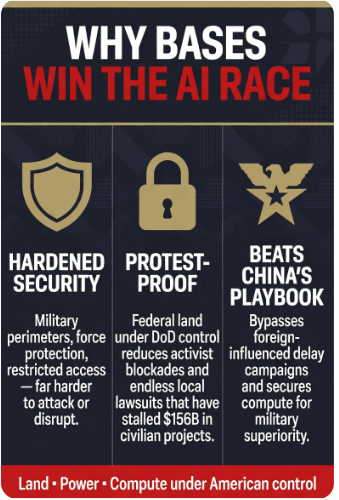
By locating these facilities on secure military land, the Pentagon bypasses much of that pressure campaign. Congress has taken the additional step of inserting language — advanced by Rep. Cory Mills of Florida — that would bar data centers on Defense Department land from using certain components manufactured in China, Russia, Iran, or North Korea. That is a direct recognition of supply-chain risk. Critics in the bureaucracy have complained it creates a “federal land penalty.” The correct response is that national security is not a penalty; it is the point.
None of this means the projects are without challenges. Water stress in places like El Paso is real. Power generation must be solved on-site or near-site without burdening civilian grids. Environmental reviews and local coordination still matter. But the alternative — continuing to site the most strategically vital computing capacity in the open civilian market, subject to endless activist delay and potential foreign influence — is far riskier.
China treats electricity and compute as national security infrastructure. The United States is finally beginning to do the same. Putting AI data centers on military bases is not militarizing the technology. It is recognizing that the technology has already become military. Secure land, private capital, mission-driven access to compute, and reduced vulnerability to both physical disruption and political obstruction form a coherent strategy.
The AI race will not be won by the nation with the best press releases or the most sensitive environmental impact statements. It will be won by the nation that can reliably generate, protect, and apply massive computing power. On that score, the Pentagon’s move to the bases is one of the clearest-eyed decisions Washington has made in years.
America first means securing the tools that will determine who leads the next era of warfare and economic power. The bases are the right place to do it.
— The Whatfinger News Team: Leads: Sgt Pat, Lisa
References
- Pentagon Plans AI Data Centers At Military Bases Across Multiple Branches
- Army reaches conditional agreement with private industry for hyperscaled data centers
- Pentagon Plans AI Data Centers at Military Bases Across Multiple Branches (Military.com)
- Accelerating Federal Permitting of Data Center Infrastructure (White House Executive Order)
- Congress ramps up scrutiny of Pentagon AI data center plans
- Foreign Influence in the Campaign against American AI

Top Features and Vids across all Whatfinger sites right now
- Dental Insurance Is a Wall Street Scam – Hardworking Americans Are Finally Doing the Math and Walking Away
- Unlikely Martyr: PATRIOTS’ TOP !0 Memes – Watch MAGA
- Mamdani’s Marxist Grocery Grab: Socialist Mayor Uses $70 Million of Your Tax Dollars to Kill Every Bodega in NYC
- “Defend Israel or Defend America?” Top General’s Blunt Warning as US Missile Cupboards Run Bare — and Factories Can’t Keep Up
- RFK Jr. Just Obliterated CNN’s Dana Bash Live: “All You Know How to Do Is Repeat ‘Trust the Experts’” – Media’s Vaccine Propaganda Machine Exposed
Get on over to Whatfinger.com – Whatfinger News does millions of pageviews a month for a reason…. Truth, Justice, the American way, plus news on the Left as well – all links from all sites gives you the true news. – CLICK HERE 🛑
Drudge Report Alternative

