


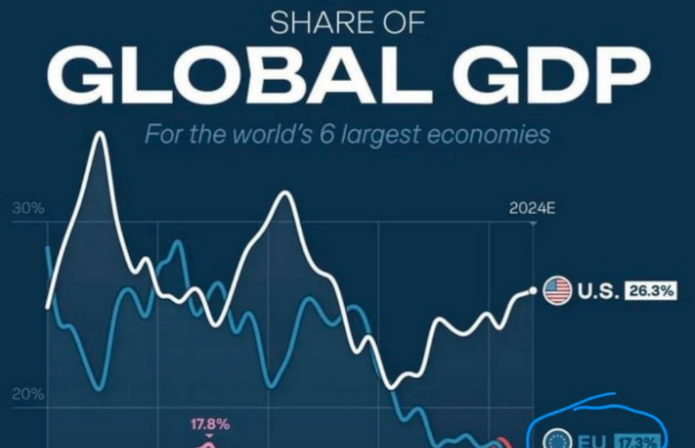

Europe never recovered from 2008. In that year the EU economy (in nominal dollars) was larger than America’s. Today the US produces nearly 50% more than the entire European Union combined, with per capita GDP almost double the EU average. Thank Socialism folks! That and open borders costing a fortune as they destroy their own people.
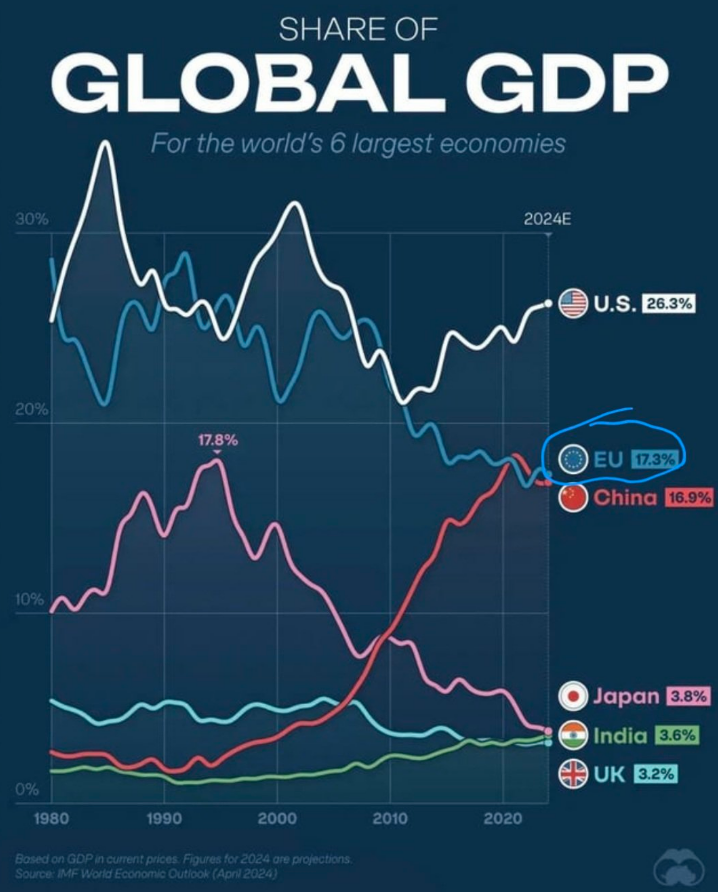
That gap isn’t a rounding error or currency glitch. It’s a canyon — and it’s still widening. The viral animated chart below is making the rounds (the one with the glowing lines and flags) shows the story in brutal clarity: two economies tracking somewhat together for decades, then the US pulling away sharply after the financial crisis while Europe stagnated.
Europe never recovered from 2008.
In 2008 the EU economy was larger than America’s. Today the US produces nearly 50% more than the entire European Union combined with per capita GDP almost double Europe’s average.
America chose innovation, energy abundance, and growth.
Europe… pic.twitter.com/TpWlbsN65s
— Rothmus 🏴 (@Rothmus) July 10, 2026
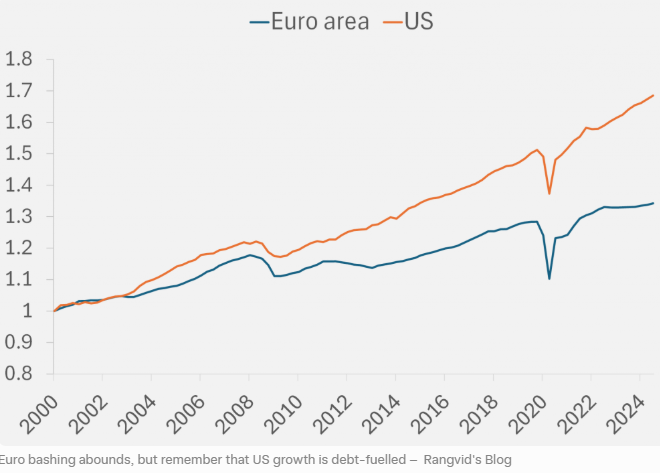
America chose (mostly) innovation, energy abundance, and growth. Europe chose regulation, green self-sabotage, welfare bloat, and Brussels bureaucrats who treat national sovereignty like an optional extra. The result? A continent that once dreamed of rivaling the American century now looks more like a museum of faded industrial glory with very expensive electricity.
The Numbers Don’t Lie — They Just Got Embarrassing
World Bank figures tell the tale without spin: EU GDP grew a measly 13.5% from 2008 to 2023 (roughly $16.37 trillion to $18.59 trillion). US GDP exploded 87% over the same period. By recent counts the US sits around $28–29 trillion while the EU hovers near $19–20 trillion.
Per capita it’s even starker. US nominal GDP per person runs roughly twice the EU average — about $86,000 versus $43,000 in recent data. The poorest U.S. state of Mississippi is now wealthier per capita than formerly Great Britain, that has thousands dying for lack of air conditioning.
This isn’t “America got lucky.” This is policy. Europe’s social-democratic model — expansive welfare, sky-high taxes on work and success, crushing regulation, and a supranational EU apparatus that overrides voters on energy, borders, and money — delivered exactly what the incentives promised: slower growth, less dynamism, and a slow bleed of competitiveness.
How Socialist-Style Policies Killed the Golden Goose
Call it what it is: Europe doubled down on the very things that punish productivity.
Energy self-sabotage dressed up as virtue. Germany’s Energiewende — the green transition that shuttered reliable nuclear plants and bet the farm on intermittent wind and solar while staying hooked on Russian gas — turned an industrial powerhouse into Europe’s problem child again. When the 2022 energy shock hit, German factories faced power costs that made US competitors laugh. Chemical giant BASF, auto icons like Volkswagen, and entire sectors in metals and manufacturing started cutting, closing, or relocating. Deindustrialization isn’t a theory in Germany; it’s a boardroom decision.
The EU’s Green Deal piled on more rules, costs, and uncertainty for small and medium businesses — the real engines of any economy. High energy prices + regulatory thicket = capital flight and “why bother innovating here?”
Welfare bloat and the incentive to coast. Generous safety nets that turned into hammocks for too many, combined with high marginal tax rates, dampened the hunger that drives entrepreneurship and risk-taking. Labor participation and hours worked lag in too many member states. Why hustle when the state extracts so much and hands out so freely? Millions of illegals and migrants now have 2, 3 or even more wives, all paid for with their many children, by the host nations of the EU. They are destroying themselves, and paying enemies of their nations to outbreed them.
Regulation as a growth suppressant. GDPR, the AI Act, endless single-market rules, and a Brussels bureaucracy that regulates everything from lightbulbs to speech created a compliance moat that favors incumbents and punishes startups. The US, for all its flaws, still lets innovators move faster. Europe regulates first, asks questions later — and wonders why it doesn’t have its own Magnificent Seven.
Mass low-skill immigration without assimilation. Europe’s migrant surges (amplified by EU policies and failed integration) added fiscal burdens on welfare systems already groaning under aging demographics. Cultural friction, parallel societies, and crime spikes in some cities became features, not bugs, of the model. Sound familiar?
Wherever countries leaned hardest into EU dictates — rigid energy rules, open-border experiments, one-size-fits-all fiscal straightjackets — the pain showed up fastest in lost industry and sluggish growth. Outliers that pushed back (on migration, on certain green mandates, or on fiscal profligacy) often fared relatively better. The pattern is consistent: more Brussels central planning and socialist-flavored redistribution correlates with relative decline.
America Got a Taste During the Biden Years — And It Wasn’t Pretty
We didn’t need to wonder what “Europizing” America looks like. The Biden administration delivered a greatest-hits version on fast-forward: trillions in spending that supercharged inflation (peaking over 9%), green mandates and subsidies that raised costs while reliability suffered, regulatory expansion across energy and business, and border policies that echoed Europe’s migrant overload without Europe’s excuses of geography or history.
Real wages took a beating for working families before partial recovery. Housing and energy costs squeezed the middle class. Cities strained under sudden migrant surges. It wasn’t full European socialism — we’re still mostly more capitalist and energetic than that — but it was the same direction: bigger government, more redistribution, more central direction of energy and borders, less emphasis on abundance and growth. The results were predictable and painful for anyone not protected by assets or government checks. Throw in tens of millions of illegals invited in by the Democrats and you can see how the Left was almost successful in toppling America. How much longer could we have lasted before the same dictatorial policies existed here as they do in the UK? Only a matter of a few years.
Europe shows what happens when you keep going that way for decades. The canyon doesn’t close itself.
The Choice Is Still Ours — For Now
America’s advantages remain real: abundant domestic energy (when we allow ourselves to produce it), a culture that still celebrates builders and risk-takers more than it punishes them, federalism that lets states compete (watch Texas and Florida versus the high-tax, high-regulation experiments), and a tech/innovation edge that Europe’s rule-makers can only dream of regulating into existence.
Europe bet on bureaucrats, virtue signaling, and managed decline. They got exactly what they incentivized.
We can still bet on drillers, builders, entrepreneurs, and the messy, glorious chaos of freedom and abundance. Or we can keep flirting with the European model and enjoy the view from the bottom of the canyon — colder, poorer, and lectured by people who never met a payroll.
The chart doesn’t lie. The policies that created it are still on offer. Choose accordingly.
Sgt Pat, Ben and Lisa at Whatfinger News
References
- GDP (current US$) – European Union, World Bank Data
- Comparing United States and European Union by Economy – StatisticsTimes (2024–2025 figures)
- Fact Check: Has the economic gap between Europe and the United States increased? – Econofact
- Reflect on Germany’s Energy Transition for Future US Strategies – Baker Institute (and related reporting on Energiewende deindustrialization impacts)
- The stagnation of Europe’s largest economy – European Strategic Think Tank analysis
The data is public. The trend is clear. The warning is loud. America cannot afford another Democrat regime.
Get on over to Whatfinger.com – Whatfinger News does millions of pageviews a month for a reason…. Truth, Justice, the American way, plus news on the Left as well – all links from all sites gives you the true news. – CLICK HERE 🛑