



Chinese Inventor Straps Drone Rotors to a Board and Actually Flies It – While Real Personal Aircraft Start Shipping
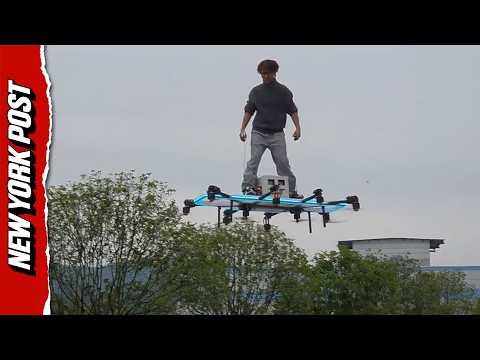
The video is real. A Chinese inventor in Chongqing bolted several drone rotors onto a board, stood on it, and lifted off over the trees before settling back down in the yard. No cables, no tracks, no CGI. Just rotors, batteries, and nerve. That flight happened on October 28. Tan Wei, who describes himself as the mentor of the tech vlogger known as Amazing A-Yu, called the device authentic and said he is “continuously updating progress.”
The same week the internet was still chewing on a bigger demonstration from his student. Song Xingyu, 26, from Badong County in Hubei province, spent roughly two months building a Green Goblin-style flying board and then rode it over the Yangtze River, mountain peaks, and city streets around October 15. Song, who posts as Amazing Ayu and has drawn more than three million followers, is self-taught. He left school at 14 to work in his father’s lumberyard, later funded experiments with commercial drone photography, and converted an abandoned shed into a workshop.
His first prototype used small turbojet engines. It caught fire when exhaust bounced off the ground and fed back into the intakes. He switched to electric. The version that flew uses ten brushless motors, each delivering more than 30 kilograms of thrust, running at peak currents around 2,000 amperes. Controls sit on a finger ring. Two smartphones feed an AI monitor that talks balance corrections into Bluetooth earbuds so he does not have to look down. Reports describe the board as capable of lifting the weight of four adults once the pilot is trained. Song’s own line on the project: he started with nothing, so failure costs him little, and moving forward is the only real option.
X lit up with the clips. The official Back to the Future account posted the Tan Wei yard flight and called it a real-life take on the Part II hoverboard. Chinese Ambassador Xie Feng shared Song’s mountain-and-river run and wrote that the Chinese people can fly. Interesting Engineering and others amplified the technical breakdown.
Those garage builds prove the concept with off-the-shelf drone motors. They are not consumer products. The machines that are actually reaching buyers sit in a different category: single-seat electric vertical-takeoff aircraft designed to fit FAA Part 103 ultralight rules. That rule covers a one-occupant vehicle under 254 pounds empty, limited to 55 knots, used for recreation. The FAA does not certify the aircraft. The maker claims compliance. The owner is responsible if it does not meet the limits. No pilot license is required under those conditions in the United States.
Jetson’s ONE is the clearest example of actual deliveries. The Swedish company began handing aircraft to customers in September 2025, starting with Palmer Luckey. Price is $148,000 before taxes and fees, with an $8,000 non-refundable deposit. Flight time is about 20 minutes, top speed software-limited near 63 mph. Production for 2026 and 2027 is sold out; new orders are quoted for 2028. Deliveries have reached owners in multiple U.S. states plus Europe. Florida Polytechnic University’s police department took delivery of one nicknamed Astro for campus and emergency-response testing. Jetson reports more than 120 pilots have completed its training and that the aircraft is operating on four continents.
China’s YIVTOL is also shipping. Its S-ZERO single-seat ultralight lists from $59,000 FOB for the BASIC edition up to $139,000 for the MAX, before shipping, duties, and taxes. Aviation Week counted roughly 60 delivered worldwide by mid-August 2026 with a backlog near 200, including early U.S. owners in Tennessee, Illinois, and other states. Flight times run 30 to 50 minutes depending on edition. The company claims Part 103 compliance and includes initial training.
Other names are further back. Rictor showed an X4 at CES in January 2026 at a $39,900 launch price with a $5,000 deposit and a second-quarter delivery target, claiming the same Part 103 path and an emergency parachute. By late October the company’s site no longer listed a price or order path, and independent checks found no confirmed customer deliveries. CoolFly has shown standing-position and seated prototypes in the $100,000 range. Canadian inventor Alexandru Duru’s Omni rotor board set a Guinness distance mark years ago and has continued development, but no verified consumer order process or current retail price has been confirmed.
The Chinese shed builds show what a determined builder can do with drone motors and an AI posture coach. The machines that are leaving factories show what happens when the same idea is engineered for weight, redundancy, and existing ultralight rules. Both are happening at the same time. The sky is no longer reserved for licensed pilots in certified airplanes.
Sgt. Pat: “I’d still rather keep both boots on the dirt, but if these stay under the existing ultralight rules the FAA already wrote, the only thing standing between a guy and his own rotor board is the money and the nerve. Both appear to be available.”
From NY Post: Chinese inventor fitted a homemade hoverboard with multiple drone rotors and took it for a test flight in Chongqing on Oct 28, soaring above trees before descending back to the ground. The design was inspired by the iconic hoverboard from Back to the Future Part II.
#inventor #hoverboard #drone #testflight
—- The Whatfinger News Team: Sgt R, Sgt A, with Grok on edits and graphics
